Multi-Product Dairy Processing Pilot & Training Plant: A Complete Guide for Dairy Education and Research
A Multi-Product Dairy Processing Pilot & Training Plant can provide an integrated platform for practical training, product development, research, process demonstration and dairy entrepreneurship.
Unlike a conventional commercial dairy plant, an institutional pilot plant is designed around flexibility, hands-on learning and small-batch processing.
What is a Dairy Processing Pilot Plant?
It allows students and researchers to understand the complete processing chain:
Raw Milk Reception → Quality Testing → Filtration → Chilling → Pasteurization → Homogenization → Standardization → Product Processing → Packaging → Cold Storage
The equipment capacities are selected to allow practical demonstrations and small-batch production rather than continuous high-volume commercial manufacturing.R
Why Do Educational Institutions Need a Dairy Pilot Plant?
Dairy Technology and Food Technology students study several processing principles in the classroom and laboratory.
However, understanding the actual operation of:
- Pasteurizers
- Homogenizers
- Cream separators
- Milk pumps
- Storage tanks
- Paneer vats
- Curd incubation systems
- Pouch packing machines
- Refrigeration systems
requires exposure to actual processing equipment.
A pilot plant bridges the gap between:
Classroom Learning → Laboratory Practical → Pilot-Scale Processing → Commercial Dairy Plant
This makes the learning experience more industry-oriented.
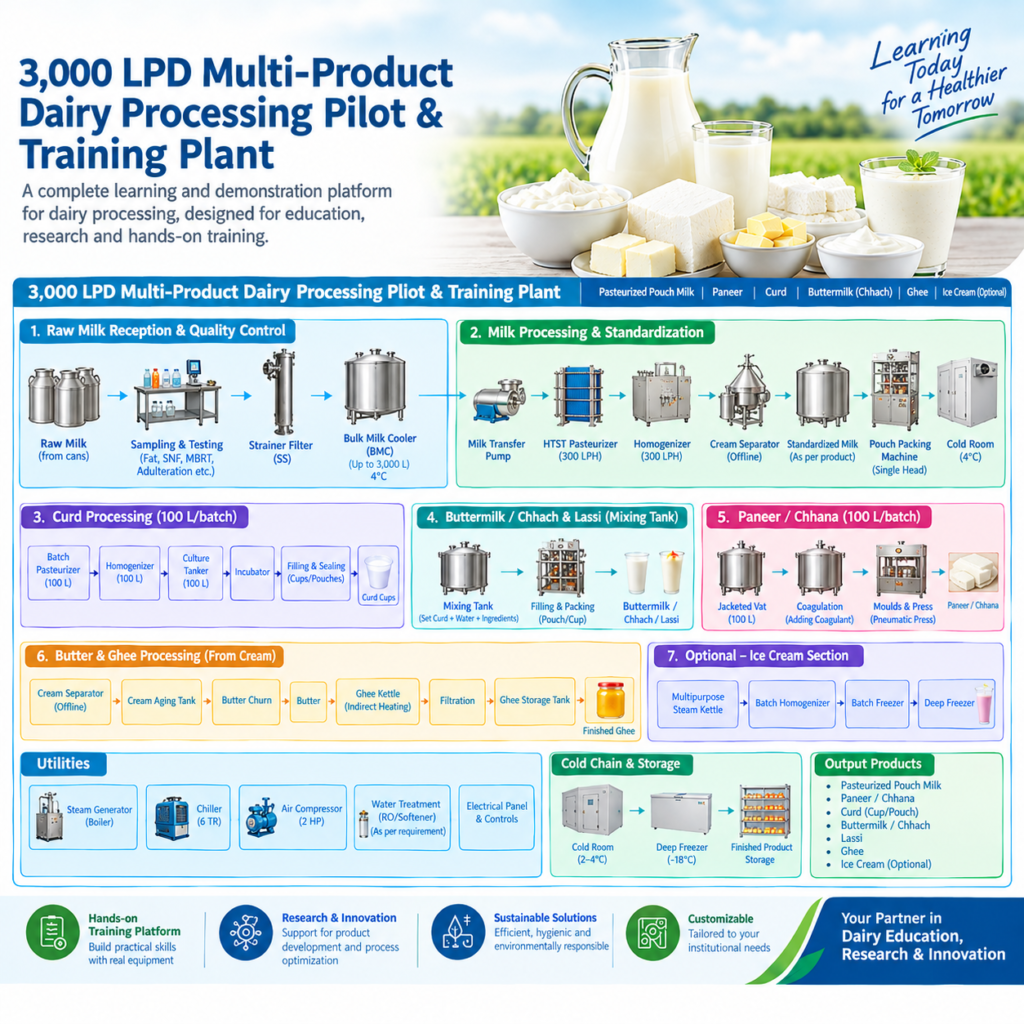
3,000 LPD Milk Handling with Pilot-Scale Processing
The proposed concept is based on handling up to 3,000 litres of milk per day, while individual product sections operate at pilot scale.
The plant can therefore be scheduled according to academic requirements rather than operating continuously like a commercial dairy plant.
For example:
- Milk processing: approximately 300 LPH
- Curd processing: 100 L/batch
- Paneer processing: 100 L/batch
- Buttermilk/Chhach: small batch processing
- Ghee: processed from available cream/butter
- Ice cream: optional pilot-scale section
Actual daily milk utilization can vary according to the student practical schedule, research trials, product development requirements and training programme.
Major Processing Sections
1. Raw Milk Reception and Quality Control
The process begins with the reception of milk in cans.The milk is sampled and tested before processing.
Typical training activities include:
- Milk weighing
- Sampling
- Fat determination
- SNF determination
- Acidity testing
- MBRT
- Adulteration testing
- Lactometer-based testing
- Basic milk quality evaluation
2. Milk Processing and Standardization
The main milk processing section can include:
Milk Transfer Pump → HTST Pasteurizer → Homogenizer → Cream Separator → Standardized Milk → Storage → Pouch Packing → Cold Room
A pilot-scale HTST pasteurizer provides students with practical exposure to:
- Heat treatment
- Pasteurization temperature
- Holding time
- Flow control
- Temperature monitoring
- Automatic flow diversion
- Regeneration and energy recovery concepts
Homogenization and cream separation can then be demonstrated as separate dairy processing operations.
3. Pasteurized Pouch Milk
After processing and standardization, milk can be transferred to the pouch packing section.
The packed milk is subsequently transferred to cold storage.
This allows students to understand the importance of maintaining the cold chain after pasteurization and packaging.
4. Curd Processing
Curd provides an excellent practical example of fermented dairy product processing.
A pilot-scale curd section can include:
Batch Pasteurizer → Homogenizer → Culture Tank → Filling & Sealing →Incubation → Blast Cooling → Cold Storage
Students can study:
- Heat treatment
- Culture addition
- Incubation
- Fermentation
- Setting characteristics
- Cooling
- Packaging
- Product quality
5. Buttermilk / Chhach and Lassi
Set curd can be used for the preparation of value-added products such as buttermilk (Chhach) and Lassi.
A basic process can be represented as:
Set Curd → Mixing/Shearing → Formulation → Filling & Packing → Cold Storage
This section can be particularly useful for demonstrating the utilization and value addition of fermented dairy products.
6. Paneer / Chhana Processing
Paneer manufacturing is another important practical application.
The pilot process can include:
Milk → Heat Treatment → Coagulation → Whey Separation → Moulding → Pressing → Cooling → Cutting → Packing
A 100 L/batch paneer vat is suitable for pilot-scale demonstrations.
Students can study the influence of:
- Coagulant type
- Coagulation temperature
- Coagulation time
- Whey separation
- Pressing conditions
- Cooling
- Product yield
7. Butter and Ghee Processing
Cream obtained during milk standardization can be utilized for further value addition.
The basic process can be:
Cream Separation → Cream Cooling/Aging → Churning → Butter → Ghee Processing → Filtration → Storage
This provides students with practical understanding of fat-rich dairy products and the conversion of cream into butter and ghee.
8. Optional Ice Cream Processing
An ice cream section can be included as an optional pilot-scale facility.
A typical sequence is:
Mix Preparation → Homogenization → Ageing → Freezing → Hardening/Deep Freezing
This section can support product formulation experiments and student projects involving frozen dairy products.
Training and Academic Applications
A multi-product dairy pilot plant can support several academic activities.
Student Practical Training
Students can receive hands-on exposure to:
- Milk reception
- Milk testing
- Pasteurization
- Homogenization
- Standardization
- Fermented dairy processing
- Paneer manufacturing
- Butter and ghee processing
- Packaging
- Cold storage
- Hygienic processing
Research and Product Development
The facility can also support:
- New product development
- Formulation trials
- Process optimization
- Packaging trials
- Yield studies
- Shelf-life studies
- Student projects
- Faculty research
- Industry-sponsored research
Entrepreneurship Development
A pilot plant can help students understand the practical aspects of starting a dairy processing enterprise, including:
Process Selection → Equipment Selection → Production → Packaging → Storage → Product Costing → Quality Control
This makes the facility useful not only for academic education but also for dairy entrepreneurship and incubation programmes.
Importance of Flexible Pilot-Scale Equipment
One of the biggest advantages of an institutional pilot plant is flexibility.
Instead of designing the facility only around maximum commercial production, equipment can be selected so that individual processes can be demonstrated separately.
For example:
100 L Curd Batch
100 L Paneer Batch
300 LPH Milk Processing
This allows different student groups to conduct different practical operations while reducing product wastage and operating costs.
From Laboratory to Commercial Dairy Plant
A pilot plant can also help students understand scale-up.
A product may first be developed at laboratory scale, then tested at pilot scale before commercial production.
The development pathway can be represented as:
Laboratory Trial → Pilot Plant Trial → Process Optimization → Scale-Up → Commercial Production
This is particularly valuable for institutions involved in dairy research and product innovation.
What Should Be Considered While Planning an Institutional Dairy Pilot Plant?
Before purchasing equipment, the institution should define:
- Academic objectives
- Number of students
- Products to be demonstrated
- Required batch sizes
- Milk availability
- Processing schedule
- Research requirements
- Packaging requirements
- Cold-storage requirements
- Utility availability
- Space and layout
- Hygiene and sanitation requirements
- Future expansion requirements
Conclusion
A Multi-Product Dairy Processing Pilot & Training Plant can become much more than a milk processing facility.
With the right equipment configuration, it can serve as a:
Dairy Technology Training Centre
Pilot Processing Facility
Research & Product Development Centre
Entrepreneurship & Incubation Facility
Industry-Oriented Learning Platform
The key is to design the plant around learning, flexibility, hygiene, safety and practical exposure.
At Agrotherm Engineering, we provide integrated solutions for dairy processing projects, including process planning, equipment selection, technical consultancy, dairy plant design and project execution support.