
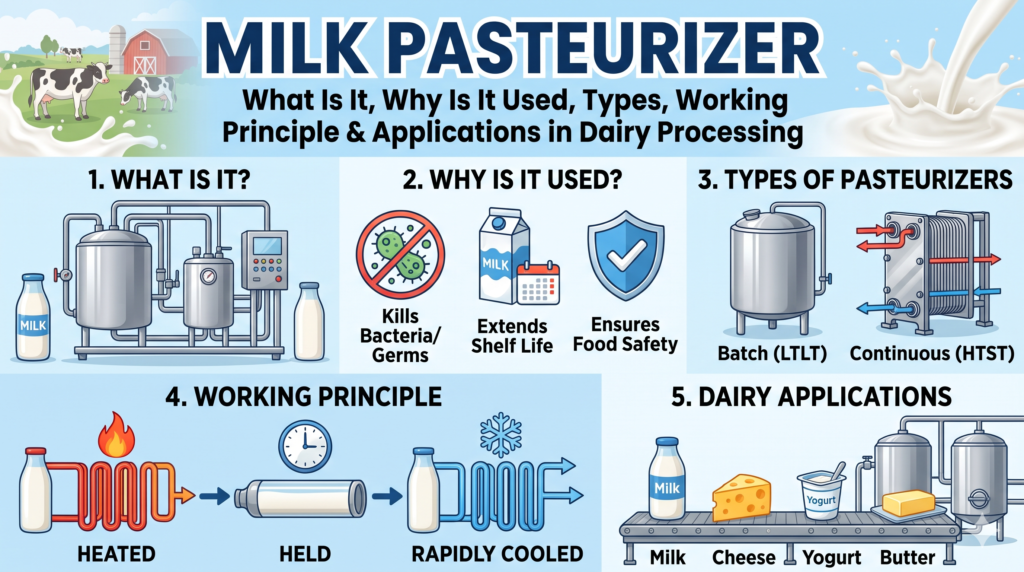
Milk Pasteurizer: What Is It, Why Is It Used, Types, Working Principle and Applications in Dairy Processing
A Complete Guide for Dairy Entrepreneurs and Milk Processing Plant Owners
Milk is a highly nutritious food, but raw milk can also contain harmful microorganisms that may cause foodborne diseases. Therefore, before milk is supplied to consumers, it generally undergoes a controlled heat treatment known as pasteurization.
A milk pasteurizer is one of the most important pieces of equipment in a dairy processing plant. However, many people starting a dairy business are not familiar with what a pasteurizer actually does, how it operates, or which type of pasteurizer they should install.
In this blog, we will explain milk pasteurization in simple language, covering its purpose, working principle, different types of pasteurizers, applications, and equipment selection.
1. What Is a Milk Pasteurizer?
A Milk Pasteurizer is a food-processing machine designed to heat milk to a predetermined temperature, maintain it at that temperature for a specified period, and then cool it rapidly to a suitable storage or processing temperature.
This controlled heat-treatment process is called Milk Pasteurization.
The primary purpose of pasteurization is to destroy disease-causing microorganisms (pathogens) and reduce the overall microbial load in milk, making it safer for human consumption.
In simple terms:
A milk pasteurizer heats milk under controlled conditions to make it microbiologically safer without subjecting it to the excessive heat treatment associated with boiling or sterilization.
Pasteurization does not make milk completely sterile. Some heat-resistant microorganisms and bacterial spores may survive. Therefore, proper hygienic handling, packaging, and refrigeration are essential after pasteurization.
2. Why Is Milk Pasteurization Necessary?
Raw milk can contain microorganisms originating from the animal, udder, milking equipment, water, transportation containers, and the surrounding environment.
Some microorganisms may cause diseases, while others can spoil milk and reduce its shelf life.
The main purposes of milk pasteurization are:
- Food Safety
Pasteurization destroys or significantly reduces important disease-causing microorganisms, helping protect consumers from milk-borne infections.
- Reduction in Microbial Load
It reduces the population of microorganisms responsible for milk spoilage and deterioration.
- Improvement in Shelf Life
When pasteurized milk is handled hygienically, packed properly, and maintained under refrigeration, its usable shelf life can be extended compared with untreated raw milk.
- Maintaining Milk Quality
A properly designed pasteurization process achieves the required microbial reduction while limiting undesirable changes in milk’s taste, flavour, and nutritional characteristics.
- Meeting Food Safety Requirements
Commercial dairy processing plants must follow applicable food safety standards and prescribed pasteurization conditions.
3. What Is the Principle of Milk Pasteurization?
The working principle of milk pasteurization is based on the relationship between Temperature and Holding Time.
Microorganisms are sensitive to heat. When milk is heated to a specified temperature and maintained for a specified duration, the targeted harmful microorganisms are destroyed or inactivated.
For example, two commonly used pasteurization methods are:
| Pasteurization method | Temperature | Holding time |
|---|---|---|
| LTLT / Batch | 63°C | 30 minutes |
| HTST / Continuous | 72°C | 15 seconds |
These are commonly recognized reference conditions for ordinary milk. The applicable Indian regulatory requirements and approved process conditions must be followed for the actual product and equipment.
The important point is that heating milk alone is not pasteurization. Both temperature and holding time must be properly controlled.
After completion of the heat treatment, milk must be cooled immediately to the required temperature to prevent unnecessary microbial growth and maintain product quality.
4. What Are the Different Types of Milk Pasteurizers?
A. Batch Pasteurizer (LTLT Pasteurizer)
The batch pasteurizer is also known as a Vat Pasteurizer or Low Temperature Long Time (LTLT) Pasteurizer.
It is suitable for small and medium-scale dairy plants, milk processing units, pilot plants, and institutions where milk is processed in individual batches.
Working Principle:
Raw milk is transferred into a stainless steel insulated processing vessel.
Milk is heated indirectly through a heating medium, generally hot water or steam in a jacket.
An agitator continuously mixes the milk to maintain uniform temperature throughout the vessel.
Milk is heated to at least 63°C and maintained at this temperature for at least 30 minutes, under the applicable validated process.
After the holding period, milk is cooled using a cooling arrangement, such as chilled water or an external cooling system.
The pasteurized milk is transferred to a storage tank or the next processing section.
Main Components:
Stainless Steel SS304 product-contact vessel
Heating jacket or heating arrangement
Insulation and outer cladding
Agitator with geared motor
Temperature sensor and temperature controller
Heating and cooling connections
Product outlet and drain
Control panel
Advantages:
Simple construction and operation
Suitable for small production capacities
Lower initial investment compared with a complete HTST system
Flexible for different milk-processing applications
Can be used for heating milk for certain dairy product manufacturing processes, subject to the required process design
Applications:
Mini dairy plants
Educational and research institutions
Pilot dairy plants
B. HTST Pasteurizer (High Temperature Short Time)
The HTST Pasteurizer is one of the most widely used systems in commercial milk processing plants.
Unlike a batch pasteurizer, an HTST pasteurizer processes milk continuously. Milk flows through a heat exchanger, is heated rapidly, held at the required temperature for a specified time, and then cooled.
It is particularly suitable for medium and large dairy plants where continuous production is required.
Working Principle:
An HTST pasteurizer generally operates through the following stages:
1. Balance Tank
Raw milk is collected in a balance tank, which maintains a continuous and controlled supply of milk to the processing system.
2. Milk Feeding Pump
A sanitary milk pump transfers milk from the balance tank to the plate heat exchanger.
3. Regeneration Section (Preheating)
Incoming raw milk passes through one side of the plate heat exchanger and gets preheated by the outgoing hot pasteurized milk flowing through the other side.
This arrangement recovers heat energy and reduces the heating and cooling requirements.
4. Heating Section
The preheated milk passes through the heating section of the plate heat exchanger, where hot water or another suitable heating medium raises its temperature to the required pasteurization temperature.
5. Holding Tube
The heated milk passes through a specially designed holding tube.
The holding tube provides the required residence time at the specified pasteurization temperature.
For the commonly used HTST reference process, milk is heated to 72°C and held for at least 15 seconds.
6. Temperature Control and Flow Diversion Valve
A temperature sensor continuously monitors the milk temperature.
If the milk has not reached the required pasteurization temperature, the flow diversion valve automatically diverts it back to the balance tank for reheating.
Only milk meeting the required temperature conditions is allowed to proceed to the cooling section.
7. Regeneration and Cooling Section
After successful pasteurization, hot milk passes through the regeneration section, transferring heat to incoming raw milk.
It is then cooled further using chilled water or an appropriate cooling medium.
8. Pasteurized Milk Storage
The cooled milk is transferred to a hygienic insulated pasteurized milk storage tank before further processing or packaging.
Major Components of an HTST Pasteurizer:
Balance tank
Sanitary milk pump
Plate Heat Exchanger (PHE)
Hot water circulation system
Holding tube
Temperature sensors
Temperature recorder/controller
Flow diversion valve
Cooling water/chilled water system
Control panel
Pasteurized milk outlet
Advantages:
Continuous milk processing
Higher production capacity
Better energy efficiency through heat regeneration
Controlled and consistent heat treatment
Compact equipment arrangement
Suitable for automated dairy plants
Applications:
Commercial milk processing plants
Milk chilling and processing facilities
Packaged milk manufacturing units
Medium and large-scale dairy industries
5. Difference Between Batch Pasteurizer and HTST Pasteurizer
Both machines perform milk pasteurization, but their operating methods and applications are different.
| Parameter | Batch Pasteurizer | HTST Pasteurizer |
|---|---|---|
| Processing method | Batch | Continuous |
| Common process | 63°C for 30 min | 72°C for 15 sec |
| Heating arrangement | Jacket / hot water system | Plate or tubular heat exchanger |
| Milk movement | Agitated in vessel | Continuous flow |
| Holding arrangement | Processing vessel | Holding tube |
| Production capacity | Small to medium | Medium to large |
| Automation | Manual / semi-automatic / automatic | Generally automatic |
| Energy recovery | Limited, depending on design | Regenerative heat recovery |
| Initial investment | Comparatively low | Comparatively high |
| Typical application | Mini dairy and pilot plants | Commercial dairy plants |
Which one should you choose?
If you are planning a small dairy plant with limited production requirements, a batch pasteurizer may be a practical and economical option.
If you are planning continuous milk processing with higher production requirements, an HTST pasteurizer is generally more suitable.
The final selection should consider daily milk handling, hourly processing capacity, product range, utilities, available space, and future expansion.
6. What Is the Role of a Milk Pasteurizer in a Complete Dairy Processing Plant?
A milk pasteurizer is not an isolated piece of equipment. It forms part of an integrated milk processing line.
A typical packaged milk processing line may include:
Raw Milk Reception → Milk Filtration → Chilling / Raw Milk Storage → Clarification / Standardization → Homogenization (if required) → Pasteurization → Cooling → Pasteurized Milk Storage → Milk Packaging
The actual process sequence depends on the type of milk, product specifications, and plant design.
For example, in a pouch milk manufacturing plant, pasteurized milk is generally cooled and stored under hygienic refrigerated conditions before being transferred to the milk pouch packing machine.
For paneer or curd manufacturing, the heat-treatment and subsequent processing conditions are selected according to the product manufacturing process.
7. Frequently Asked Questions (FAQs) About Milk Pasteurizers
Q1. What is the main purpose of a milk pasteurizer?
The main purpose is to destroy or reduce harmful microorganisms in milk through controlled heating and holding, making it safer for consumption.
Q2. Is pasteurized milk the same as boiled milk?
No. Pasteurization is a controlled heat-treatment process involving specific temperature and holding time. Boiling is a different heat-treatment process.
Q3. What is the normal temperature for milk pasteurization?
Two commonly used reference conditions are 63°C for 30 minutes (batch process) and 72°C for 15 seconds (HTST process). The actual process must comply with applicable regulations and product-specific requirements.
Q4. Can a batch pasteurizer be used for paneer manufacturing?
Yes, a suitably designed batch processing vessel can be used for heating milk for paneer manufacturing. However, a normal market-milk pasteurization cycle and paneer milk heat-treatment process are not necessarily the same.
Q5. Does a pasteurizer remove all bacteria from milk?
No. Pasteurization reduces harmful microorganisms to the required level but does not destroy all microorganisms or bacterial spores.
Q6. Does pasteurized milk need refrigeration?
Yes. Conventional pasteurized milk must be protected from contamination and maintained under the prescribed refrigeration conditions throughout storage and distribution.
Q7. What is the difference between a pasteurizer and a homogenizer?
A pasteurizer uses controlled heat treatment to reduce harmful microorganisms. A homogenizer mechanically reduces fat globule size and helps prevent cream separation. Both machines perform different functions and may be installed in the same milk processing line.
Q8. Which pasteurizer is suitable for a 500 LPD dairy plant?
A batch pasteurizer may be a suitable option for a 500 LPD dairy plant, depending on the production schedule, product range, available utilities, and required processing capacity.
Q9. Can a pasteurizer be operated using steam?
Yes. Steam can be used as a heating utility, either directly in a suitable system or indirectly through a jacket or hot water circulation arrangement. For milk processing, indirect heating is commonly used.
8. Conclusion: Choosing the Right Milk Pasteurizer for Your Dairy Business
Milk pasteurization is an essential operation in dairy processing. It helps improve milk safety, reduce microbial load, and extend the usable shelf life of milk when combined with hygienic handling and proper refrigeration.
The choice of pasteurizer depends on the production capacity, type of dairy products, processing requirements, utility availability, automation level, and investment budget.
A small dairy entrepreneur may start with a batch pasteurizer, while a commercial milk processing plant may require an automated HTST pasteurization system.
Understanding the difference between these systems helps dairy entrepreneurs make informed equipment-selection decisions and establish an efficient milk processing plant.
About Agrotherm Engineering
Agrotherm Engineering is a dairy processing consultancy and engineering solutions company specializing in dairy plant planning, process design, equipment selection, dairy farm infrastructure, and turnkey dairy project solutions.
We support entrepreneurs, existing dairy businesses, and institutions in setting up, expanding, and modernizing dairy processing facilities.
Our Services Include:
Dairy Plant Planning and Project Development
Process Design and Engineering
Milk Pasteurizers and Dairy Processing Equipment
Mini Dairy Plant Setup
Equipment Selection, Sourcing and Supply
Plant Installation and Commissioning Support
Dairy Plant Modernization and Expansion
Whether you are planning a small 500 LPD dairy plant or a large commercial milk processing facility, Agrotherm Engineering can assist you in selecting the right processing equipment and developing an efficient dairy processing system.
Looking for a Milk Pasteurizer or planning to set up a dairy processing plant?
Contact Agrotherm Engineering for technical consultation and equipment solutions.
Website: https://agrothermengineering.com
Contact: 9625587414 / 9015531769
Email: agrothermeng@gmail.com