Dairy Processing Plant Consultancy: A Complete Guide to Planning and Setting Up Your Dairy Business
Starting a dairy processing business is an exciting opportunity for entrepreneurs, dairy farmers, startups, and investors. With growing demand for milk, paneer, curd, ghee, and other dairy products, a well-planned dairy processing unit can become a promising business venture.
However, establishing a dairy plant involves much more than purchasing machinery. It requires careful planning of processing capacity, product selection, plant layout, equipment specifications, utilities, investment, and future expansion.
This is where Dairy Processing Plant Consultancy Services play an important role.
At Agrotherm Engineering, we support dairy entrepreneurs and existing dairy businesses with technical consultancy, project planning, equipment selection, and project development guidance to help them make informed decisions at every stage of their dairy project.

What Is Dairy Processing Plant Consultancy?
Dairy Processing Plant Consultancy is a professional service that helps entrepreneurs plan, develop, and improve dairy processing facilities.
A dairy consultant provides technical guidance on selecting the right processing technology, determining plant capacity, preparing project reports, evaluating equipment suppliers, and planning the infrastructure required for production.
The objective is to help clients develop a practical project plan based on their business goals, investment capacity, product range, and operational requirements.
Whether you are planning a small milk processing unit or a larger dairy plant, professional consultancy can help you understand the technical and commercial considerations before making major investments.
Why Is Consultancy Important Before Setting Up a Dairy Plant?
Many new entrepreneurs begin their projects by searching for dairy equipment and collecting quotations. However, purchasing machinery before finalizing the project requirements can lead to equipment mismatches, unnecessary expenditure, space constraints, and difficulties during installation.
A systematic planning process helps address these challenges.
1. Selecting the Right Processing Capacity
The capacity of a dairy plant should be based on milk availability, expected sales, product demand, and future business plans.
For example, a business planning to process 500 litres of milk per day may have very different equipment and utility requirements from a plant designed for 5,000 litres per day.
Consultancy helps assess the proposed capacity and identify the major requirements for processing, storage, packaging, and utilities.
Benefit: Better alignment between production capacity, investment, and business objectives.
2. Choosing the Right Product Range
A dairy business may focus on pasteurized milk, paneer, curd, ghee, or a combination of products.
Each product requires a different processing approach and equipment configuration. For example, a paneer plant requires coagulation, pressing, cooling, cutting, and suitable packaging arrangements, while a pasteurized milk plant requires appropriate heat treatment, cooling, storage, and packaging systems.
Benefit: A more suitable equipment configuration based on the products you intend to manufacture.
3. Preparing a Detailed Project Report (DPR)
A Detailed Project Report helps organize the technical and financial aspects of a proposed dairy processing unit.
Depending on the project scope, it may include:
Project overview and proposed processing capacity
Product mix and process flow
Machinery and equipment requirements
Plant infrastructure and utility requirements
Estimated capital investment and operating expenses
Preliminary financial projections and business feasibility
A DPR can also support discussions with banks, financial institutions, and potential investors. Financing approval depends on the lender’s assessment and applicable requirements.
Benefit: A clearer understanding of project requirements, estimated investment, and financial planning.
4. Planning the Plant Layout and Process Flow
An effective plant layout considers the movement of milk, ingredients, finished products, personnel, and cleaning operations.
It also considers hygienic zoning, equipment access, drainage, storage, and provisions for future expansion.
Poor layout planning can create operational difficulties and make cleaning, maintenance, and material movement more complicated.
Benefit: Better space utilization, smoother process flow, and improved operational planning.
5. Selecting Suitable Dairy Processing Equipment
Equipment selection is one of the most important decisions in a dairy project.
The selection process should consider processing capacity, product characteristics, construction material, operating parameters, automation requirements, cleaning arrangements, energy consumption, and maintenance needs.
Depending on the project, equipment may include:
Milk reception and storage systems
Milk pasteurizers
Cream separators and homogenizers
Paneer coagulation vats and presses
Curd processing and filling equipment
Ghee processing systems
CIP (Cleaning-in-Place) systems
Milk chilling and refrigeration equipment
Packaging machinery
Comparing suppliers only on purchase price may overlook differences in specifications, scope of supply, performance, and after-sales support.
Benefit: More informed equipment purchasing decisions and reduced risk of selecting unsuitable machinery.
6. Estimating Utility Requirements
Dairy processing plants require utilities such as electricity, water, refrigeration, and, where applicable, steam or other heating systems.
The actual requirements depend on the processing capacity, equipment selection, operating schedule, and product mix.
Utility planning helps identify these requirements before equipment procurement and infrastructure development.
Benefit: Better infrastructure planning and a more realistic assessment of project costs.
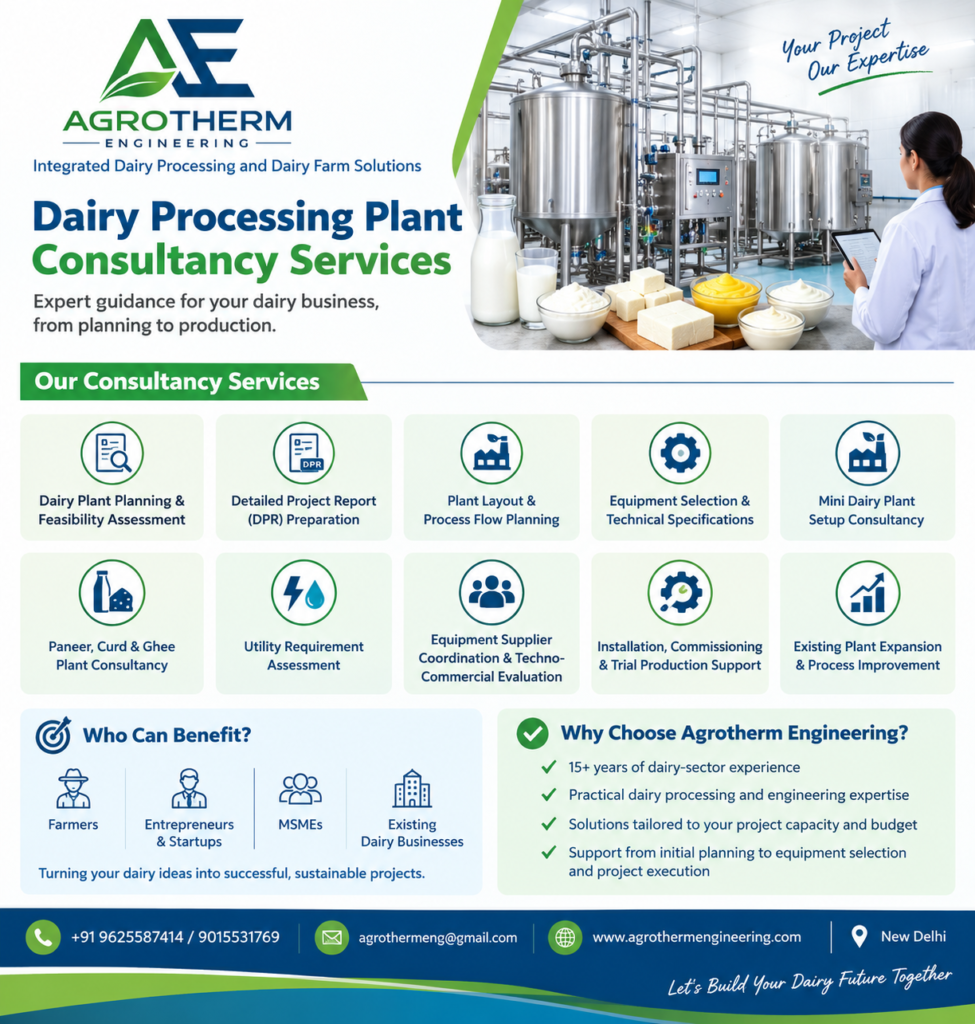
What Consultancy Services Does Agrotherm Engineering Offer?
Agrotherm Engineering provides technical consultancy and project development support for dairy processing projects.
Our services include:
Project Planning and Feasibility Assessment: Understanding project objectives, milk availability, product demand, processing capacity, and investment considerations.
DPR Preparation: Organizing the technical and commercial information required for project evaluation and financial planning.
Plant Layout and Process Flow: Planning equipment placement and process arrangements according to the proposed production requirements.
Equipment Selection and Technical Specifications: Identifying suitable equipment configurations and preparing technical requirements for supplier enquiries.
Techno-Commercial Evaluation: Comparing supplier quotations, specifications, and commercial terms to support informed purchasing decisions.
Utility Planning: Assessing the principal utility requirements associated with the proposed processing operations.
Installation and Commissioning Support: Providing technical guidance and coordination during equipment installation, commissioning, and trial production, subject to the agreed project scope.
Plant Expansion and Process Improvement: Supporting existing dairy businesses in evaluating capacity expansion, equipment upgrades, and operational improvements.
Our consultancy covers projects involving pasteurized milk, paneer, curd, ghee, and mini dairy processing plants.
Who Needs Dairy Processing Plant Consultancy?
Dairy consultancy can be useful for several types of businesses.
New Dairy Entrepreneurs and Startups
If you are entering the dairy business for the first time, consultancy can help you understand the process, equipment requirements, investment considerations, and project development stages.
Dairy Farmers Planning Value Addition
Farmers who want to process their milk into paneer, curd, ghee, or packaged milk can evaluate suitable processing options and infrastructure requirements.
Investors and MSMEs
Investors and small businesses can use technical consultancy to assess project requirements before committing funds to machinery and infrastructure.
Existing Dairy Processing Units
Operating plants may require consultancy for capacity expansion, new product lines, equipment replacement, or process improvement.
Educational Institutions and Training Centres
Institutions planning dairy pilot plants can seek technical guidance on equipment selection, process demonstration requirements, layout, and laboratory or training applications.
How Does the Dairy Plant Consultancy Process Work?
A structured consultancy engagement generally follows these stages.
Step 1: Initial Project Discussion
The client shares the proposed location, milk processing capacity, product range, available investment, and business objectives.
Step 2: Requirement Assessment
The technical requirements are assessed to identify the main processing operations, equipment, infrastructure, and utilities.
Step 3: Project Planning
The proposed process flow, plant configuration, equipment requirements, and scope of work are developed according to the agreed objectives.
Step 4: Technical and Commercial Evaluation
Equipment specifications and supplier quotations are evaluated against the project requirements.
Step 5: Project Execution Support
Where included in the consultancy agreement, technical coordination continues through procurement, installation, commissioning, and trial production.
The exact deliverables depend on the project size and the services agreed upon.
Why Choose Agrotherm Engineering?
Agrotherm Engineering combines dairy processing knowledge with practical engineering and project planning experience.
With 15+ years of experience in the dairy sector, our consultancy approach focuses on understanding the client’s requirements before recommending equipment or project configurations.
We aim to help clients:
Understand the technical requirements of their proposed dairy plant.
Choose equipment appropriate to their processing capacity and product range.
Evaluate machinery specifications and supplier quotations.
Plan plant layout and utilities before procurement.
Identify potential project constraints at an early stage.
Make informed decisions about investment and project execution.
Our objective is to provide practical, project-specific technical guidance rather than a one-size-fits-all solution.
When Should You Contact a Dairy Consultant?
The ideal time to consult a dairy professional is before finalizing equipment purchases or committing to major infrastructure expenditure.
Early consultation allows the project requirements to be evaluated as a complete system. This can help reduce avoidable changes and improve coordination between processing equipment, utilities, plant layout, and packaging operations.
Even if you have already collected equipment quotations or selected a location, consultancy may help review the proposed configuration and identify requirements that need further attention.
Start Your Dairy Processing Project with the Right Planning
A successful dairy processing project begins with a clear understanding of the business objectives, processing requirements, equipment configuration, and investment plan.
Whether you are planning a mini dairy plant, a paneer processing unit, a pasteurized milk plant, or an expansion of an existing facility, professional consultancy can help you approach the project with greater technical clarity.
Agrotherm Engineering is here to support your dairy processing journey with project planning, DPR preparation, plant layout guidance, equipment selection, utility planning, and technical project development services.
Have a dairy processing project in mind? Share your proposed processing capacity, product range, project location, and investment considerations with us to discuss the next steps.
Contact Agrotherm Engineering
Website: https://agrothermengineering.com
Email: agrothermeng@gmail.com
Phone: +91 9625587414
Agrotherm Engineering — Integrated Dairy Processing and Dairy Farm Solutions.