
Paneer Processing Plant: Process, Equipment and Plant Setup Guide
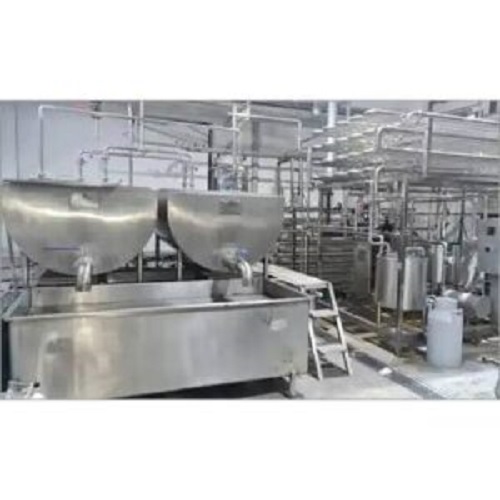
Paneer is one of the most popular milk products in India, widely used by households, restaurants, hotels, caterers, and food manufacturers. With growing demand for fresh and packaged paneer, setting up a well-planned paneer processing plant can be an attractive opportunity for dairy entrepreneurs.
However, successful paneer production requires more than simply purchasing equipment. The milk quality, coagulation conditions, pressing pressure, cooling process, hygiene practices, packaging method, and plant layout all influence the quality and shelf life of the final product.
Agrotherm Engineering supports dairy entrepreneurs with paneer processing plant planning, equipment solutions, process guidance, and project consultancy.
What is a paneer processing plant?
A paneer processing plant is a dairy processing facility designed to convert milk into paneer through controlled heating, coagulation, curd handling, pressing, cooling, cutting, and packaging.
Depending on the production capacity and business requirements, a plant may be designed for small-scale, semi-automatic, or larger commercial production.
Typical applications include:
Fresh paneer production for local markets.
Packaged paneer for retail distribution.
Bulk paneer supply to hotels, restaurants, and caterers.
Paneer production for supermarkets and food-service businesses.
Expansion of an existing dairy plant into paneer manufacturing.
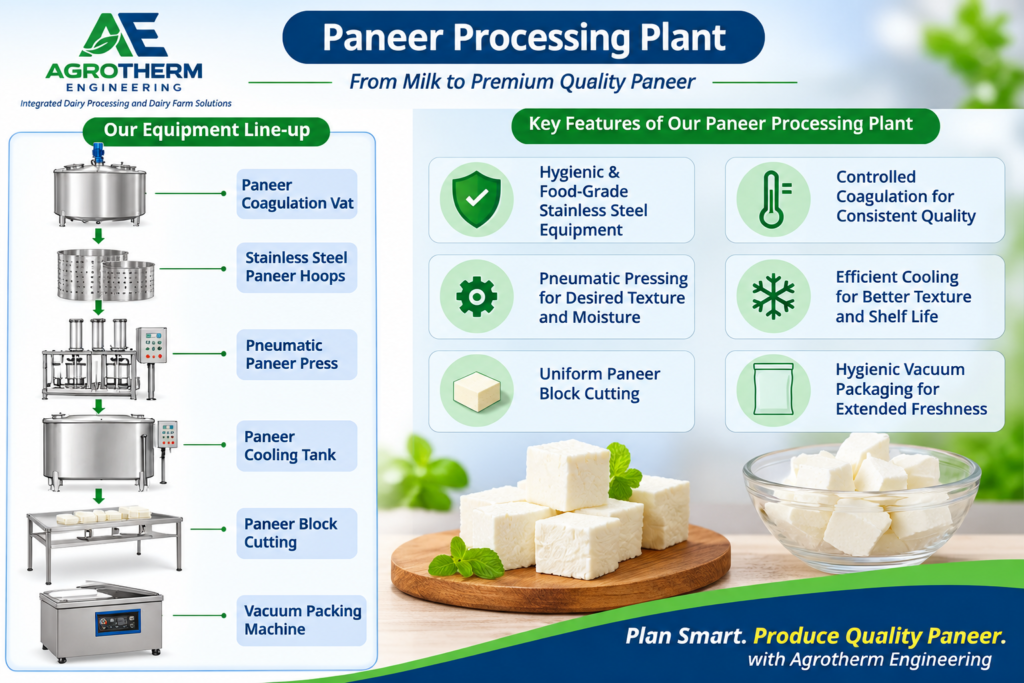
Paneer processing flow diagram
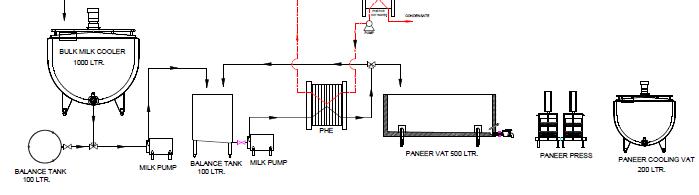
Major equipment required for a paneer processing plant
1. Paneer Coagulation Tank
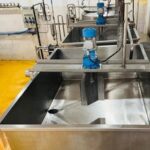
The tank is used for heating milk to the required coagulation temperature and adding food-grade coagulant under controlled conditions. Proper temperature control and gentle mixing help achieve uniform curd formation.
2. Stainless Steel Paneer Hoops
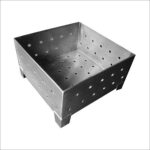
The coagulated curd is filled into perforated stainless steel hoops, allowing whey to drain during pressing. The hoop dimensions determine the block size and influence the ease of handling.
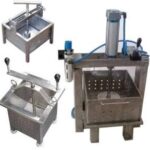
3. Paneer Press
The press applies controlled pressure to the curd-filled hoops, removing excess whey and forming compact paneer blocks. Pressing pressure and duration should be selected according to the required moisture, firmness, and texture.
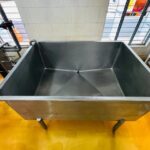
4. Paneer Cooling Vat
Pressed paneer blocks are immersed in chilled water to reduce product temperature and develop the desired texture. The cooling system and water-handling arrangements should support hygienic operation.
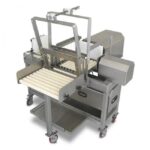
5. Paneer Cutting Arrangement
After cooling and draining, paneer blocks are cut manually or using a suitable cutting machine into the required block, slab, or cube sizes.
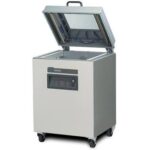
6. Vacuum Packaging Machine
Paneer portions are packed in compatible preformed pouches and sealed using a vacuum packaging machine. The packaging material and vacuum settings must be suitable for the product and intended storage conditions.
Step-by-step paneer manufacturing process
Step 1: Milk reception and preparation
Fresh milk is received and tested for relevant quality parameters, including fat, SNF, acidity, and sensory condition. Filtration and standardization are carried out as required by the product specification and process design.
Step 2: Heating and coagulation
The prepared milk is heated to the specified temperature. A suitable food-grade coagulant, commonly an acid solution, is then added gradually under controlled conditions to form curd and separate whey.
The required temperature, coagulant concentration, and endpoint depend on the milk composition and the desired paneer characteristics. These parameters should be established through process trials.
Step 3: Curd transfer and whey drainage
The coagulated curd is transferred into stainless steel paneer hoops. The system should allow efficient whey drainage while minimizing curd loss and unnecessary product handling.
Where appropriate, whey can be collected separately for evaluation and potential further utilization.
Step 4: Pneumatic pressing
The hoops are placed in a pneumatic Paneer Press. Controlled pressing removes additional whey and forms blocks with the desired firmness and moisture content. Excessive or insufficient pressing can affect texture, yield, and block integrity.
Step 5: Cooling in a Paneer Cooling Vat
The pressed blocks are immersed in chilled water to bring down their temperature and help develop a firm, cohesive texture. The chilled water must be hygienically managed, and cooling time should be established according to block dimensions and the required final temperature.
Step 6: Cutting and vacuum packaging
After cooling, the paneer blocks are removed, drained, and cut manually or mechanically. The portions are packed in suitable preformed pouches and sealed in a vacuum packing machine.
Step 7: Chilled storage and dispatch
The packaged paneer is transferred promptly to suitable refrigerated storage. Storage temperature, packaging integrity, handling practices, and validated shelf life are important for maintaining product quality and safety.
Key factors affecting paneer quality and yield
Factor | Why it matters |
|---|---|
Milk composition | Influences solids recovery, yield, and texture. |
Heating conditions | Affect protein behaviour and curd formation. |
Coagulation temperature and pH | Influence moisture retention, firmness, and curd quality. |
Coagulant addition | Incorrect concentration or mixing can cause uneven curd formation. |
Pressing pressure and time | Determine block firmness and moisture content. |
Cooling conditions | Affect texture and the speed of temperature reduction. |
Packaging and refrigeration | Help protect product quality during storage and distribution. |
Paneer yield should be estimated using the actual milk composition and validated production trials. A single yield figure should not be assumed for all milk types and operating conditions.
How to plan a paneer processing plant
Before purchasing equipment, analyse the complete project to avoid unnecessary investment and equipment mismatches.
Production capacity: Establish the milk input per batch or per day and the desired paneer output.
Raw milk availability: Assess daily supply, seasonal variation, and milk quality.
Market requirements: Determine whether the business will supply retail shops, restaurants, hotels, distributors, or institutional customers.
Equipment sizing: Match the coagulation tank, hoops, press, cooling vat, and packaging machine to the intended production schedule.
Utilities: Evaluate water, refrigeration, heating, compressed air for the pneumatic press, drainage, and electrical requirements.
Plant layout: Arrange processing, cooling, packaging, and finished-product storage to support hygienic product flow.
Project cost: Include equipment, installation, utilities, building modifications, packaging materials, working capital, and operating costs.
Food safety: Plan hygienic design, cleaning procedures, potable water, personnel practices, and applicable food business compliance.
Why choose Agrotherm Engineering?
Agrotherm Engineering provides technical support for dairy processing and dairy farm projects, helping entrepreneurs make informed decisions before investing in equipment.
Our support can include:
Paneer processing plant planning and process selection.
Equipment selection and technical specification development.
Equipment sourcing and techno-commercial evaluation.
Plant layout and utility planning.
Project cost estimation and feasibility support.
Installation coordination and commissioning assistance, as agreed for the project.
Whether you are planning a small paneer unit or expanding an existing dairy plant, equipment selection should be guided by the complete production requirement rather than by individual machines alone.
A successful paneer processing plant depends on the right combination of milk quality, process control, suitable equipment, hygienic handling, effective cooling, and appropriate packaging.
Plan the project first, select equipment according to your production needs, and then proceed with implementation.
Agrotherm Engineering supports dairy entrepreneurs with integrated dairy processing and dairy farm solutions.
Planning a paneer processing plant? Contact Agrotherm Engineering to discuss your capacity, process requirements, equipment selection, and project needs
Agrotherm Engineering
Agrotherm Engineering provides customized Dairy Processing, Dairy Farming and HVAC solutions focused on efficiency, reliability, and sustainable growth.
Contact Us
Phone: 9015531769/9625587414
Email: agrotherneng@gmail.com info@agrothermengineering.com
Dwarka Mor, Vipin Garden, Kakrola, New Delhi, 110075