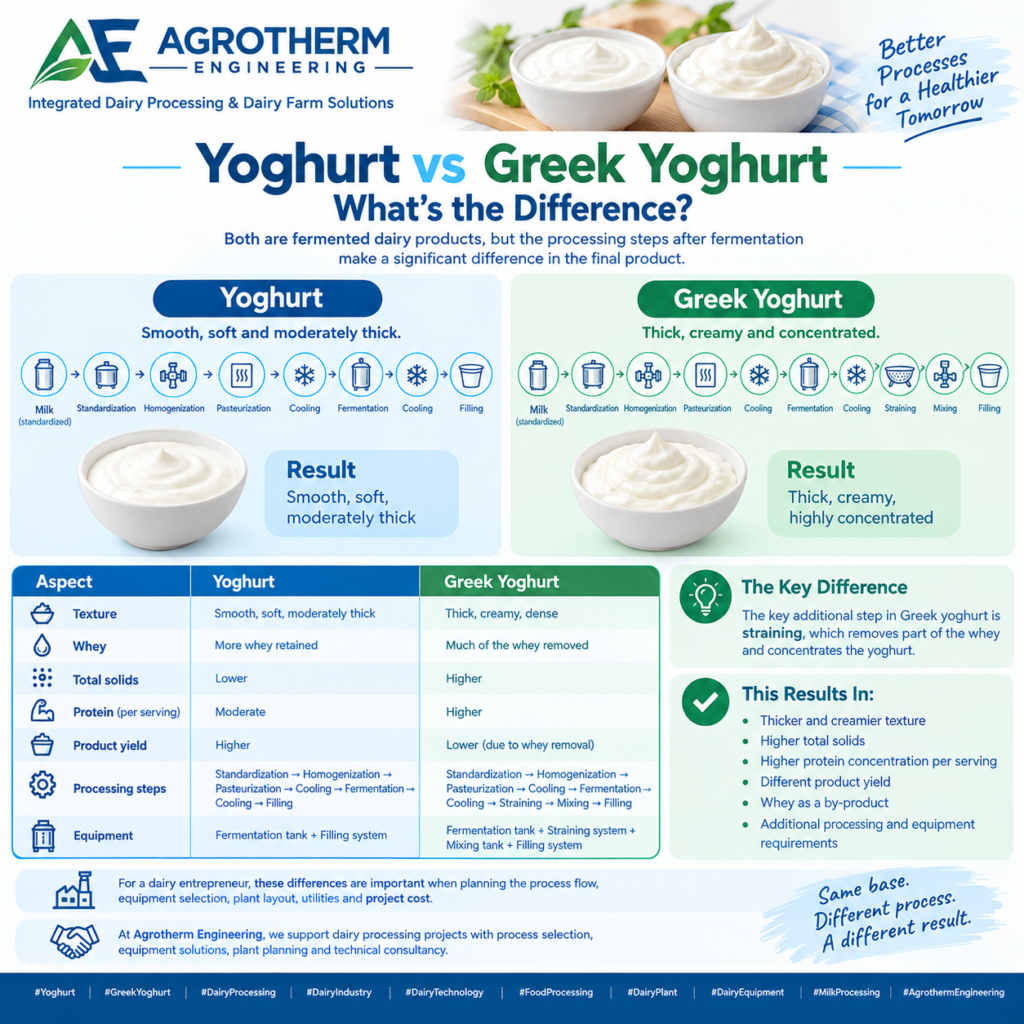
Yoghurt and Greek yoghurt are both popular fermented dairy products, but they are different in terms of processing, texture, consistency, solids content and equipment requirements.
The main difference is simple:
Greek yoghurt is concentrated yoghurt.
After fermentation, Greek yoghurt undergoes an additional straining or separation step to remove part of the whey, resulting in a thicker and creamier product.
For dairy entrepreneurs planning a yoghurt or Greek yoghurt production unit, understanding this difference is important because the processing line and equipment configuration can be different.
Protein: Greek yogurt contains roughly double the protein (about 15–20 grams per cup) compared to regular yogurt (about 8–10 grams per cup) because the protein becomes concentrated during straining.
Carbohydrates and Sugar: Greek yogurt generally has fewer carbs and lower total sugar because much of the lactose-containing whey is strained away.
Calcium: Regular yogurt often contains more calcium because calcium is retained in the liquid whey, which is partially lost when Greek yogurt is strained.
Yoghurt is a fermented dairy product made by fermenting milk with suitable yoghurt cultures.
A typical yoghurt manufacturing process involves:
Milk Reception → Standardization → Homogenization → Pasteurization → Cooling → Starter Culture Addition → Fermentation → Cooling → Filling & Packing
During fermentation, the yoghurt cultures convert lactose into lactic acid. This causes the milk proteins to form a gel structure, giving yoghurt its characteristic texture and acidic taste.
Depending on the formulation and process, yoghurt can be manufactured as set yoghurt, stirred yoghurt or drinking yoghurt.
Greek yoghurt is a thicker, more concentrated form of yoghurt.
The milk is first processed and fermented in a manner similar to conventional yoghurt. After fermentation, an additional concentration or straining step is carried out.
The straining process removes part of the whey from the fermented yoghurt. This increases the concentration of milk solids and produces a product with a thicker, creamier and denser texture.
A typical Greek yoghurt process is:
Milk Reception → Standardization →Homogenization → Pasteurization → Cooling → Starter Culture → Fermentation → Straining/Concentration → Mixing → Cooling → Filling & Packing
Straining is not simply a filtration step. It is an important concentration operation that determines the characteristics of the finished product.
During straining:
Fermented Yoghurt → Whey Separation → Concentrated Yoghurt
The removal of whey increases the concentration of milk solids in the retained yoghurt.
This is why Greek yoghurt generally has a thicker and denser consistency than conventional yoghurt.
However, straining also produces whey as a by-product. For commercial production, whey handling and utilization should therefore be considered during plant planning.
A small or medium-scale Greek yoghurt processing plant may include equipment such as:
The exact equipment configuration depends on the plant capacity, product formulation, processing method, packaging format and level of automation.
For conventional yoghurt production, the process can end after fermentation, cooling and filling, depending on the type of yoghurt.
For Greek yoghurt, an additional concentration stage is required.
Therefore:
Yoghurt Plant
Fermentation → Cooling → Filling
Greek Yoghurt Plant
Fermentation → Straining/Concentration → Mixing → Cooling → Filling
This additional processing stage needs to be considered when preparing the plant layout, equipment list, utility requirements, production capacity and project cost.
For conventional yoghurt production, the process can end after fermentation, cooling and filling, depending on the type of yoghurt.
For Greek yoghurt, an additional concentration stage is required.
Therefore:
Yoghurt Plant
Fermentation → Cooling → Filling
Greek Yoghurt Plant
Fermentation → Straining/Concentration → Mixing → Cooling → Filling
This additional processing stage needs to be considered when preparing the plant layout, equipment list, utility requirements, production capacity and project cost.
There is no single answer because the two products serve different market requirements.
Conventional yoghurt can be suitable for products such as dahi, stirred yoghurt, drinking yoghurt and other fermented dairy products.
Greek yoghurt is particularly suitable where the market demands a thick, creamy and concentrated yoghurt product.
For a dairy entrepreneur, the decision should be based on factors such as:
The fundamental difference between yoghurt and Greek yoghurt is the additional concentration or straining step used in Greek yoghurt production.
While both products are based on fermented milk, Greek yoghurt undergoes whey removal after fermentation, producing a thicker and more concentrated product.
For anyone planning a Greek yoghurt manufacturing unit, the straining system, mixing arrangement, whey handling and filling system should be considered during the initial plant design rather than added later.
A properly planned processing line can help achieve consistent product quality while making efficient use of milk, utilities and processing equipment.
Agrotherm Engineering provides technical consultancy and engineering support for dairy processing projects, including:
If you are planning a yoghurt, Greek yoghurt or other dairy processing plant, the process and equipment configuration should be developed according to your required capacity and final product specification.
Agrotherm Engineering
Integrated Dairy Processing & Dairy Farm Solutions