Setting up a dairy processing unit is not simply a matter of purchasing dairy equipment and installing it in a building.
One of the common mistakes made by new dairy entrepreneurs is to directly approach equipment fabricators, discuss a few machines and start collecting quotations—before properly analysing the project.
This can result in unsuitable equipment, unnecessary investment, inadequate utilities, poor plant layout and difficulties during actual production.
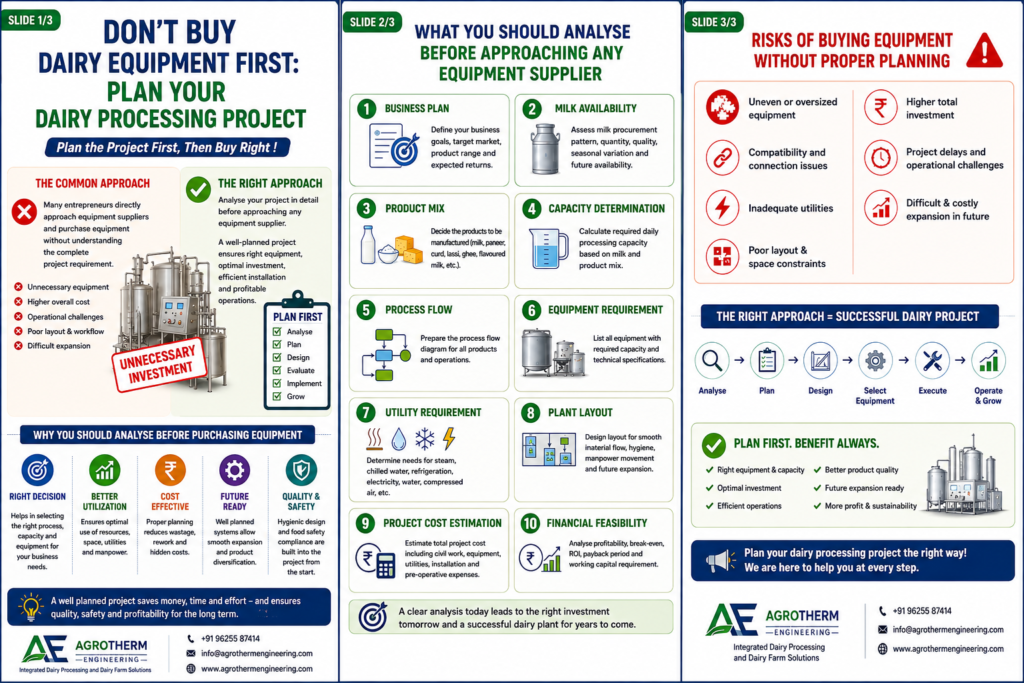
A successful dairy processing project should begin with project analysis and engineering planning, followed by equipment selection and procurement.
Equipment Purchase Is Not the First Step
When an entrepreneur decides to start a dairy processing business, the first question should not be:
“Which equipment should I purchase?”
Instead, the project should begin with questions such as:
- How much milk will be available?
- What products will be manufactured?
- What will be the daily production capacity?
- Who are the target customers?
- What is the expected selling price?
- What investment is required?
- What utilities will the plant need?
- What space is available?
- What food-safety requirements need to be considered?
- What is the expected profitability?
- Can the plant be expanded in the future?
Only after these questions are analysed should equipment specifications be finalized.
1. Start With the Business Plan
Before designing the plant, understand the business model.
For example, a dairy entrepreneur may plan to manufacture:
- Pasteurized milk
- Paneer
- Curd
- Lassi
- Buttermilk
- Ghee
- Flavoured milk
Each product requires a different process, equipment configuration, utilities and packaging arrangement.
Therefore, product selection should come before equipment selection.
2. Determine the Milk Availability
The available milk quantity is one of the most important factors in determining plant capacity.
For example:
Available milk → 500 L/day
does not automatically mean that you should purchase a 500 LPH processing plant.
You need to analyse:
- Milk collection pattern
- Morning and evening procurement
- Seasonal variation
- Future milk availability
- Milk composition
- Expected increase in procurement
Plant capacity should be decided based on the complete project requirement, not simply today’s milk availability.
3. Finalize the Product Mix
Product mix has a direct impact on plant design.
For example, a plant processing 1,000 litres of milk per day could have completely different equipment requirements depending on whether it produces:
Only pasteurized milk
or
Milk + paneer + curd + lassi + ghee.
The second project requires a more diversified process and equipment arrangement.
Therefore:
Milk availability → Product mix → Production capacity → Process flow → Equipment
is a better approach.
4. Prepare the Process Flow
Before approaching an equipment fabricator, prepare the process flow diagram.
For example:
Milk Reception → Filtration → Chilling → Storage → Standardization → Pasteurization → Homogenization → Product Processing → Packaging → Cold Storage
The actual flow will vary depending on the products being manufactured.
A properly developed process flow helps determine:
- Equipment required
- Equipment capacity
- Product transfer requirements
- Pipeline routing
- Utility requirements
- Space requirements
- Cleaning arrangements
5. Calculate the Equipment Requirement
Once the process flow is finalized, determine the equipment required.
Instead of asking:
“What equipment do you manufacture?”
the entrepreneur should have a clear equipment requirement based on the process.
Depending on the project, this may include:
- Milk reception system
- Bulk milk cooler
- Milk storage tanks
- Milk transfer pumps
- Pasteurizer
- Homogenizer
- Paneer equipment
- Curd processing equipment
- Cream separator
- Ghee processing equipment
- Packaging machine
- Cold storage
- CIP system
Not every dairy plant needs all of these machines.
Equipment should be selected according to the process—not the other way around.
6. Analyse Utilities Before Buying Equipment
A dairy plant requires more than processing equipment.
You may need:
- Electrical power
- Water
- Hot water
- Steam
- Refrigeration
- Chilled water
- Compressed air
- Drainage
- Effluent management
If utilities are not calculated properly, the plant may face problems after installation.
For example, purchasing a pasteurizer without considering the required heating and cooling utilities can create operational problems later.
7. Prepare the Plant Layout
Equipment should not be purchased before understanding where it will be installed.
The plant layout should consider:
- Raw milk reception
- Processing area
- Product processing
- Packaging
- Finished product storage
- Cold room
- Utility area
- CIP area
- Personnel movement
- Material movement
- Drainage
- Hygiene and sanitation
A cheaper machine may become an expensive decision if it does not fit properly into the planned plant layout.
8. Consider Food Safety and Compliance
Dairy plants need to be designed with food safety and hygiene in mind.
The project should consider:
- Hygienic equipment design
- Food-contact materials
- Cleaning and sanitation
- Drainage
- Cross-contamination prevention
- Personnel flow
- Raw and finished product areas
- Applicable regulatory requirements
These considerations should be incorporated during the design stage, rather than after equipment installation.
9. Analyse the Project Financially
Before investing in equipment, understand the economics of the complete project.
The analysis should include:
Investment
- Land/building
- Civil work
- Dairy processing equipment
- Utilities
- Electrical installation
- Refrigeration
- Packaging
- Laboratory
- Installation
- Working capital
Operating costs
- Milk
- Labour
- Electricity
- Fuel
- Packaging material
- Maintenance
- Transportation
- Other operating expenses
Revenue
Estimate revenue based on:
Product quantity × selling price
Then analyse:
- Gross margin
- Operating expenses
- Net profit
- Break-even
- Return on investment
- Working capital requirement
This helps determine whether the proposed project is commercially viable.
10. Why Buying Equipment Directly Can Become Expensive
Buying individual equipment directly from different fabricators may sometimes appear cheaper.
However, the entrepreneur may later discover:
- Equipment capacities don’t match
- Connections are different
- Pumps are incorrectly sized
- Utilities are inadequate
- Layout needs modification
- Additional equipment is required
- Automation is incompatible
- Pipeline requirements were overlooked
- Installation costs were underestimated
The initial quotation may look attractive, but the total project cost can become much higher.
What Should You Do Before Approaching a Fabricator?
Before requesting equipment quotations, prepare at least these basic documents:
Project analysis
↓
Product mix
↓
Capacity calculation
↓
Process flow
↓
Mass balance
↓
Equipment list & specifications
↓
Utility calculations
↓
Plant layout
↓
Project cost estimation
↓
Financial feasibility
↓
Equipment procurement
This approach allows you to compare quotations on the basis of the same technical requirements.
Fabricator vs. Project Consultant
A fabricator’s primary role is generally to manufacture and supply equipment according to the required specifications.
But before approaching the fabricator, the entrepreneur needs to understand:
What equipment is actually required, what capacity it should have, how it should connect with other equipment, and how the complete plant should operate.
This is where project planning and engineering consultancy become important.
The objective is not to avoid fabricators.
The objective is to approach the right fabricator with a clearly defined project requirement.
The Right Approach to a Dairy Processing Project
A successful dairy project should follow a structured approach:
Business Concept
↓
Market & Product Analysis
↓
Milk Availability
↓
Product Mix
↓
Capacity Selection
↓
Process Flow
↓
Mass Balance
↓
Equipment Selection
↓
Utility Planning
↓
Plant Layout
↓
Cost & Financial Analysis
↓
Equipment Procurement
↓
Installation & Commissioning
↓
Production
Final Thought
Don’t start your dairy project by asking, “What equipment should I buy?”
Start by asking:
“What dairy processing business do I want to build, and what does the complete project require?”
Once the project is properly analysed, equipment procurement becomes much easier, more transparent and more cost-effective.
Planning a Dairy Processing Unit?
Agrotherm Engineering provides integrated dairy processing solutions including:
- Dairy Plant Design & Engineering
- Process & Equipment Selection
- Utility Planning
- Plant Layout
- Project Feasibility & DPR
- Technical Consultancy
- Equipment Solutions
- Project Implementation Support
Before approaching equipment fabricators, get your dairy project technically analysed and properly planned.
Agrotherm Engineering — Integrated Dairy Processing and Dairy Farm Solutions